Cannabis businesses already produce a steady stream of security information. Cameras record activity. Alarm systems report conditions. Access systems log doors and credentials. Policies define expected behavior. Employees notice exceptions that technology may miss.
The problem is rarely a complete lack of data. The problem is that the data remains separated, arrives without context, or reaches leadership after the moment for a useful decision has passed. A security intelligence pipeline is the operating discipline that turns scattered signals into prioritized, human-reviewed action.
A camera event is not automatically intelligence. Neither is an alarm, a door-access record, an incident note, or a new regulatory bulletin. Each is a signal. Its meaning depends on timing, location, operating conditions, expected activity, and the reliability of the source.
Consider a simple example. Motion appears in a restricted area after hours. By itself, that event may indicate a threat, scheduled maintenance, an authorized manager, or a camera configuration problem. When the event is compared with access records, the facility schedule, alarm status, visitor authorization, and a staff report, the business can ask a much better question: does this activity match an approved operating condition, or does it require escalation?
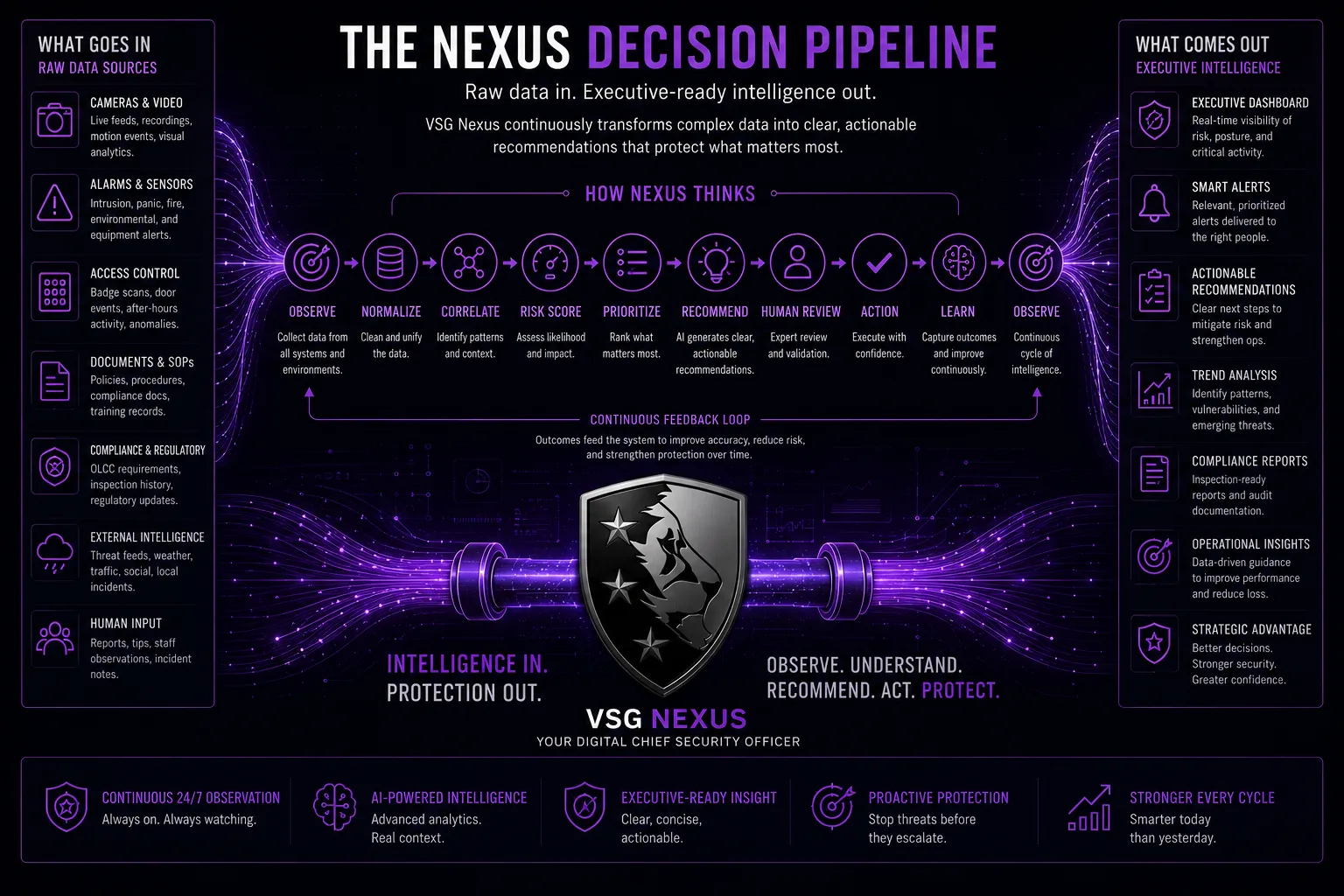
That is the purpose of the decision pipeline shown in the infographic:
Observe. Collect relevant information from facility systems, operating records, external conditions, and people.
Normalize. Align timestamps, locations, names, severity definitions, and data formats so unlike systems can be compared accurately.
Correlate. Look for related events, recurring exceptions, or changes that are more meaningful together than separately.
Assess and prioritize. Estimate likelihood, consequence, urgency, and confidence. Put the most important questions in front of the right person first.
Recommend. Present a clear course of action, the evidence behind it, and any important uncertainty.
Review and act. Keep a qualified human responsible for validation, authorization, and the consequences of the decision.
Learn. Record the outcome, false alarms, missed context, and corrective actions so the process improves.
This approach is consistent with the governance principles in the NIST AI Risk Management Framework, which emphasizes defined roles, documented context, measurement, ongoing monitoring, and clear responsibility for human-AI oversight. For a cannabis operator, those safeguards are not abstract. They help prevent a weak data source, an unclear alert threshold, or an automated recommendation from becoming an unexamined operational decision.
The pipeline also needs boundaries. Collect only information that has a legitimate security purpose. Restrict access according to role. Document retention expectations. Test whether alerts are useful. Give operators a way to correct bad context and override a recommendation. Intelligence should reduce uncertainty without creating unnecessary surveillance, privacy exposure, or false confidence.
The goal is not to automate judgment. It is to give judgment better inputs, clearer priorities, and a reliable feedback loop.
Operational standard
A cannabis leadership team can begin with six questions:
What decisions are we trying to improve? Start with decisions such as after-hours escalation, opening and closing exceptions, access review, alarm response, and incident reporting.
Which sources are authoritative? Identify who owns each system or record, how current it is, and what a failure or gap looks like.
What creates priority? Define severity, business impact, time sensitivity, and confidence instead of treating every alert as equal.
Who reviews and who authorizes? Name the person responsible for checking context and the person empowered to act.
What must be documented? Preserve the evidence, decision, response, and required regulatory or law-enforcement notifications.
How does the system improve? Review false positives, delayed escalations, recurring vulnerabilities, and incomplete corrective actions.
The goal is not to automate judgment. It is to give judgment better inputs, clearer priorities, and a reliable feedback loop.
Nexus insight
The infographic presents the target operating model for VSG Nexus: a Digital Chief Security Officer layer designed to connect security signals, facility context, procedures, and leadership decisions. Its value should be measured by whether it helps a qualified person understand what changed, why it matters, what evidence supports the recommendation, and what action remains accountable to a human.
Nexus should complement cameras, alarms, access control, SOPs, managers, and security professionals. It should never be described as a substitute for any of them.
Work with VSG
VSG can help cannabis operators map their existing security information, identify the decisions that matter most, and build a practical path from disconnected alerts to accountable operational intelligence.