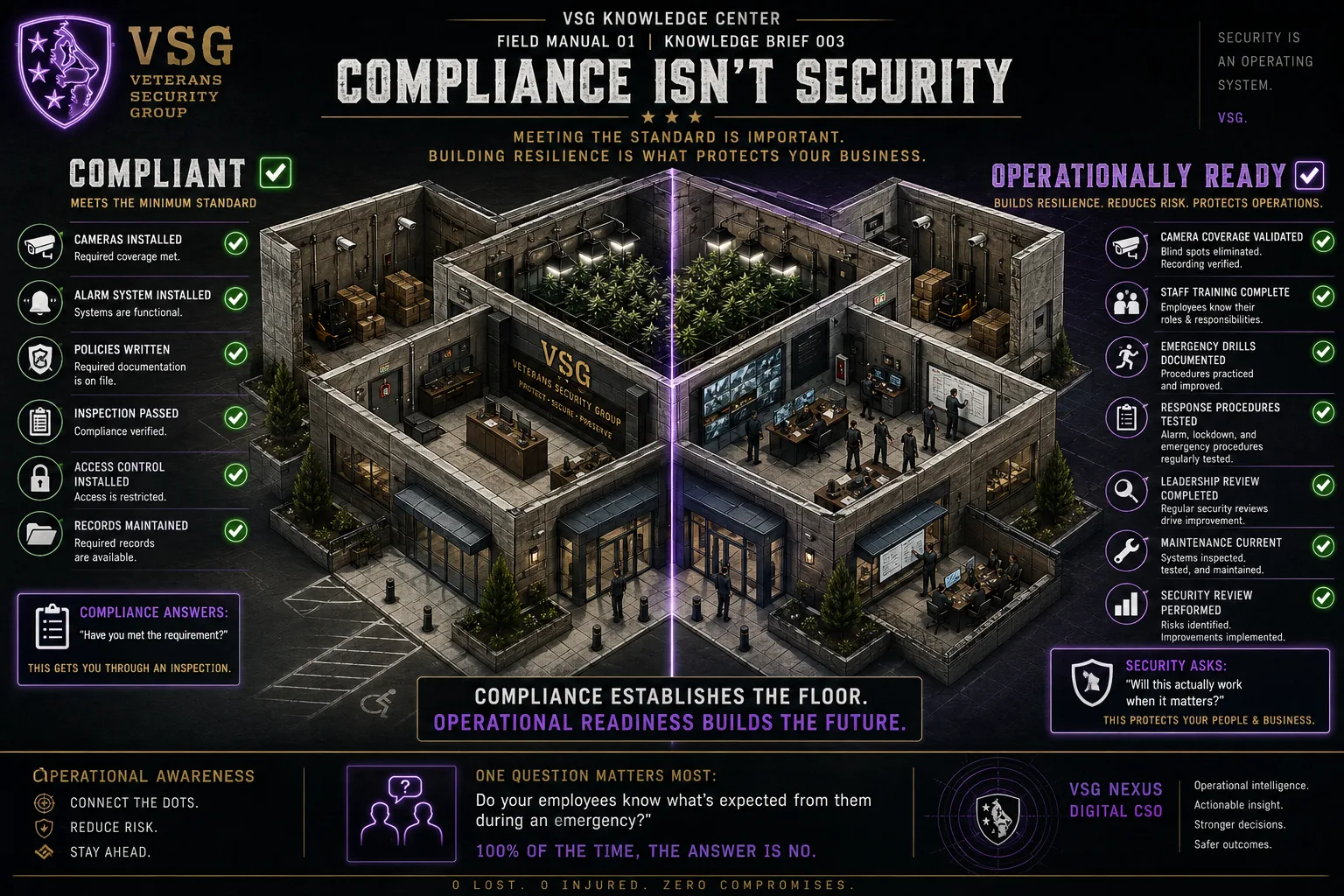
Compliance is essential. Oregon cannabis operators must understand and follow current OLCC rules, maintain required security controls, preserve records, and meet reporting obligations. Those requirements create a necessary baseline.
But a compliant facility can still be unprepared. A camera may be installed but poorly positioned. An alarm may function but reach the wrong contact. A written procedure may satisfy documentation expectations while the closing team has never practiced it. Compliance asks whether a requirement has been met. Operational readiness asks whether the protection will actually work when conditions are difficult.
The difference becomes clear during opening, closing, an alarm activation, a medical event, a power interruption, a threatening encounter, or a theft. These moments do not unfold like an inspection checklist. Employees have limited time, incomplete information, and competing responsibilities. The quality of the response depends on preparation completed before the incident.
In March 2025, the Oregon Liquor and Cannabis Commission reported an increase in burglaries and armed robberies affecting licensees. The OLCC bulletin noted that burglaries were often occurring in early morning hours and armed robberies were centering around closing time. Its recommendations went beyond simply owning security equipment: discuss the security plan with staff, consider multiple employees at opening and closing, know panic-button locations, confirm alarms and cameras are working, maintain awareness, and report suspicious or threatening activity.
That is operational readiness in practical form. It connects the control to the person, the procedure, and the decision.
Readiness also requires maintenance and change control. The OLCC's 2026 surveillance update illustrates that regulatory requirements evolve. Facilities change too: walls move, storage practices shift, employees change roles, vendors gain temporary access, and new systems are added. A security configuration that passed review last year should not be assumed to remain effective today.
Emergency planning follows the same logic. OSHA's emergency action plan rule identifies minimum plan elements and requires covered employees to understand the plan when it is developed, when their responsibilities change, and when the plan changes. CISA's emergency-planning guidance further emphasizes training and exercises as a way to identify resource gaps, improve coordination, and turn a document into a usable response.
For cannabis leadership, the question is not whether compliance and readiness compete. They reinforce each other. Compliance defines important obligations. Readiness tests whether the organization can meet those obligations while protecting employees, customers, inventory, evidence, and continuity of operations.
Compliance asks whether a requirement has been met. Operational readiness asks whether the protection will actually work when conditions are difficult.
Operational standard
An operationally ready cannabis business should be able to demonstrate more than installation:
Coverage is validated. Camera views, lighting, recording, alarm signals, access points, and failure notifications are tested under real operating conditions.
Employees know their roles. Opening, closing, escalation, evacuation, medical, and incident-reporting responsibilities are taught by position and shift.
Procedures are exercised. Short tabletop discussions and practical drills reveal ambiguity before an emergency does.
Response contacts are current. Managers, monitoring providers, security personnel, property contacts, and emergency services have clear activation rules.
Maintenance is visible. Defects, service dates, temporary workarounds, and overdue repairs are documented and escalated.
Leadership reviews risk. Incidents, near misses, false alarms, access exceptions, and corrective actions reach the people who can allocate resources.
After-action improvement is required. Every meaningful incident or exercise produces assigned corrective actions and a follow-up date.
The aim is not more paperwork. It is confidence based on evidence.
Nexus insight
A Digital Chief Security Officer layer can help organize readiness evidence across facilities: what was tested, what failed, who owns the correction, when the next review is due, and which patterns deserve leadership attention. That visibility can reduce the distance between a compliance record and an operational decision.
The system should support people, not certify readiness by itself. Qualified leaders must still test conditions, validate context, approve actions, and confirm that corrections were completed.
Work with VSG
VSG can conduct a cannabis security readiness review that looks beyond installed equipment to the people, procedures, maintenance, and decision paths that determine how the business performs under pressure.