KB-004
FM-01
Fact-verified July 21, 2026 · Owner review
4 min read
Garrit Hunt
The Decision Pipeline

FULL-READING VSG INFOGRAPHIC
VSG-KB004-COVER-01
Opening thesis
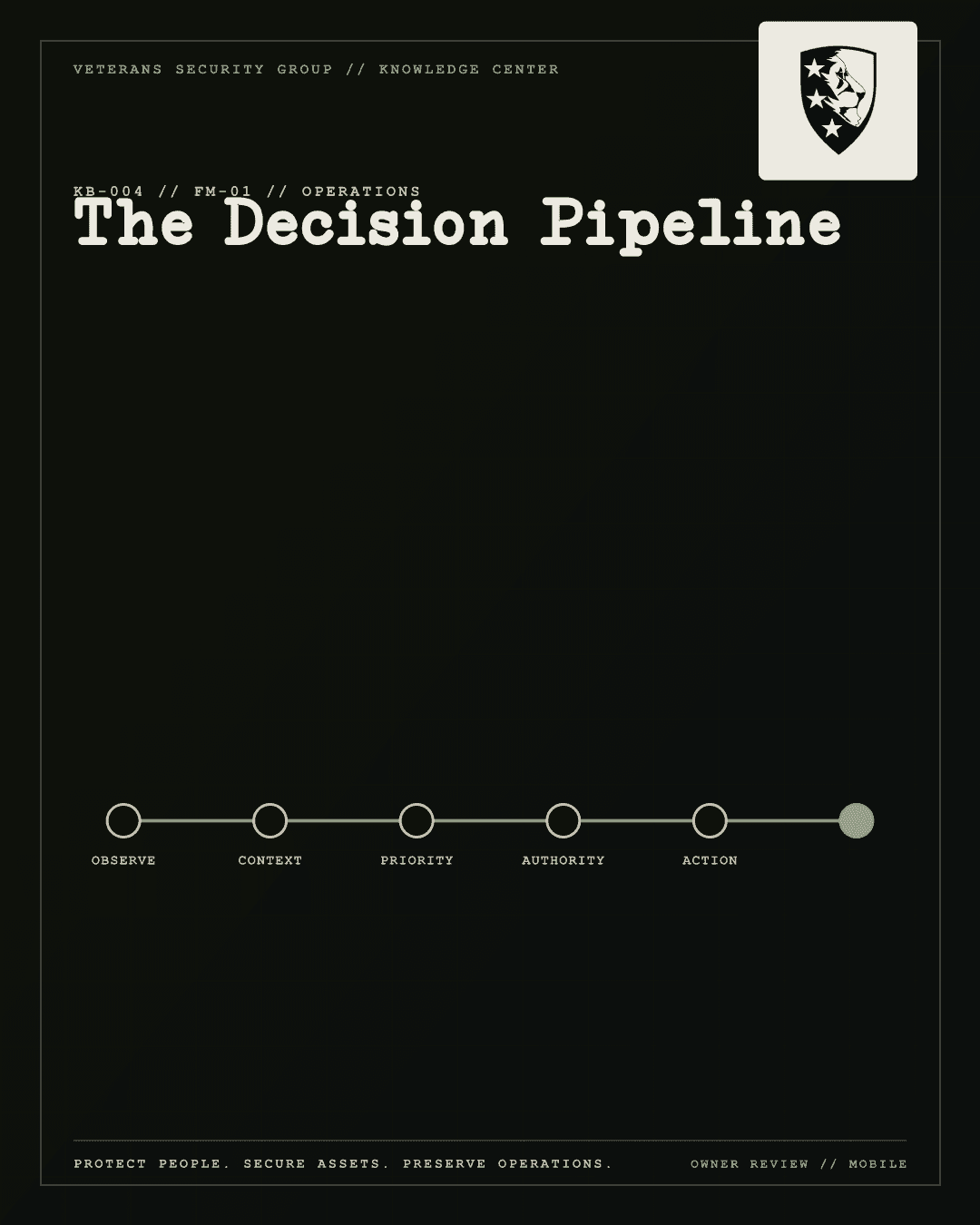
Information becomes security intelligence only when it supports a decision. A camera event, employee report, service ticket, audit finding, or threat notice may be important, but it has no operational value until the organization can place it in context, route it to someone with authority, act, and verify the result. The VSG Decision Pipeline is the doctrine that connects those steps without removing human judgment.
Start with an observation, not a conclusion
The pipeline begins by capturing what was observed. Good capture separates direct fact from interpretation. “A restricted door was open at 9:12 p.m.” is different from “an intrusion occurred.” The first statement can be checked against access records, schedules, video, maintenance activity, and staff accounts. The second may assign motive before evidence supports it.
Useful observations include time, location, source, affected operation, and any immediate protective action already taken. They should also preserve uncertainty. If the source is incomplete or unverified, say so. Accuracy at intake prevents urgency from turning an assumption into organizational truth.
Not every observation belongs in the same workflow. Routine exceptions, urgent safety conditions, compliance-related changes, and executive threats require different handling. The pipeline should keep those paths clear while maintaining one doctrine for accountability.
Add context and establish priority
Context answers the question, “What does this mean here?” The same event can carry different significance based on the asset involved, operating hours, recent incidents, known maintenance, personnel changes, and the reliability of the source. Context is what allows leaders to distinguish noise from a condition that requires action.
Priority should reflect consequence and time sensitivity, not emotion. VSG doctrine recommends considering potential harm, operational disruption, compliance impact, evidence decay, and the reversibility of a delayed decision. A high-consequence condition with incomplete information may require an interim protective action while facts are developed. A low-consequence issue may be placed into scheduled review.
This stage should produce a concise decision statement: what is known, what remains unknown, why it matters, and when a decision is needed. If the recipient has to reconstruct the entire event, the pipeline has not done its job.
Route authority with the issue
Escalation is effective only when the recipient can make or sponsor the required decision. Sending every issue to the highest-ranking person creates congestion. Sending it to someone without authority creates delay.
The organization should define decision rights before an incident. Who may suspend access, stop an activity, approve emergency spending, contact authorities, preserve sensitive records, or accept a temporary exposure? Primary and backup roles should be clear. The pipeline can then route the issue according to the decision required, not simply according to organizational habit.
Human authorization remains central. Automated rules may notify, assemble context, or flag a deadline, but they should not obscure who approved the action. The record should show the decision, the accountable owner, the intended result, and any limits placed on the response.
Verify the action and close the loop
Completion is not the same as effectiveness. A work order may be closed while the underlying exposure remains. A policy may be issued without reaching the people who must follow it. A credential may be disabled in one system and remain active in another.
Verification asks whether the intended condition now exists. The evidence can be proportional: a test result, an access review, a photograph, a supervisor confirmation, a retrieved recording, or a documented exercise. If verification fails, the issue returns to the appropriate stage rather than being buried under a second task.
The final step is learning. Significant events and repeated minor conditions should inform procedures, training, control design, and escalation thresholds. That feedback makes the pipeline a management system instead of a ticket queue.
FIELD OBSERVATION
A program can be strong at detection and weak at closure. It may generate alerts quickly, but ownership becomes unclear after the first notification. Reports accumulate, temporary fixes become permanent, and leaders receive activity summaries without a clear statement of residual risk. A visible decision pipeline exposes where work is waiting and whether the organization is improving the condition that produced it.
NEXUS INSIGHT
VSG Nexus is positioned as a human-led Digital Chief Security Officer layer for a client-authorized decision process. Its purpose is to support an operational picture in which observations, context, ownership, decisions, and verification can be understood together. Nexus does not replace the client’s authority structure or make independent operational decisions. The doctrine remains the same with or without a platform: the right issue must reach the right person, and closure must be supported by evidence.