Executive protection is often reduced to a visible person standing near a principal. That image misses most of the work. A mature program is built before movement begins: understand the threat, identify vulnerabilities, plan the environment, coordinate people and communications, prepare for medical and emergency contingencies, and keep reassessing as conditions change.
For cannabis leaders, that risk-based approach matters. Owners and executives may move between licensed facilities, public events, investor meetings, court or regulatory appointments, residences, and travel locations. Their exposure can change quickly based on publicity, business disputes, a recent incident, predictable routines, or conditions around a facility.
The ASIS Executive Protection Standard begins with a security risk assessment. It calls for a structured program that considers the individual's visibility, value to the organization, prior threats, operational needs, communications, emergency response, documentation, and continuous evaluation. That is a useful foundation because protection should be proportional to risk, not driven by appearance or prestige.
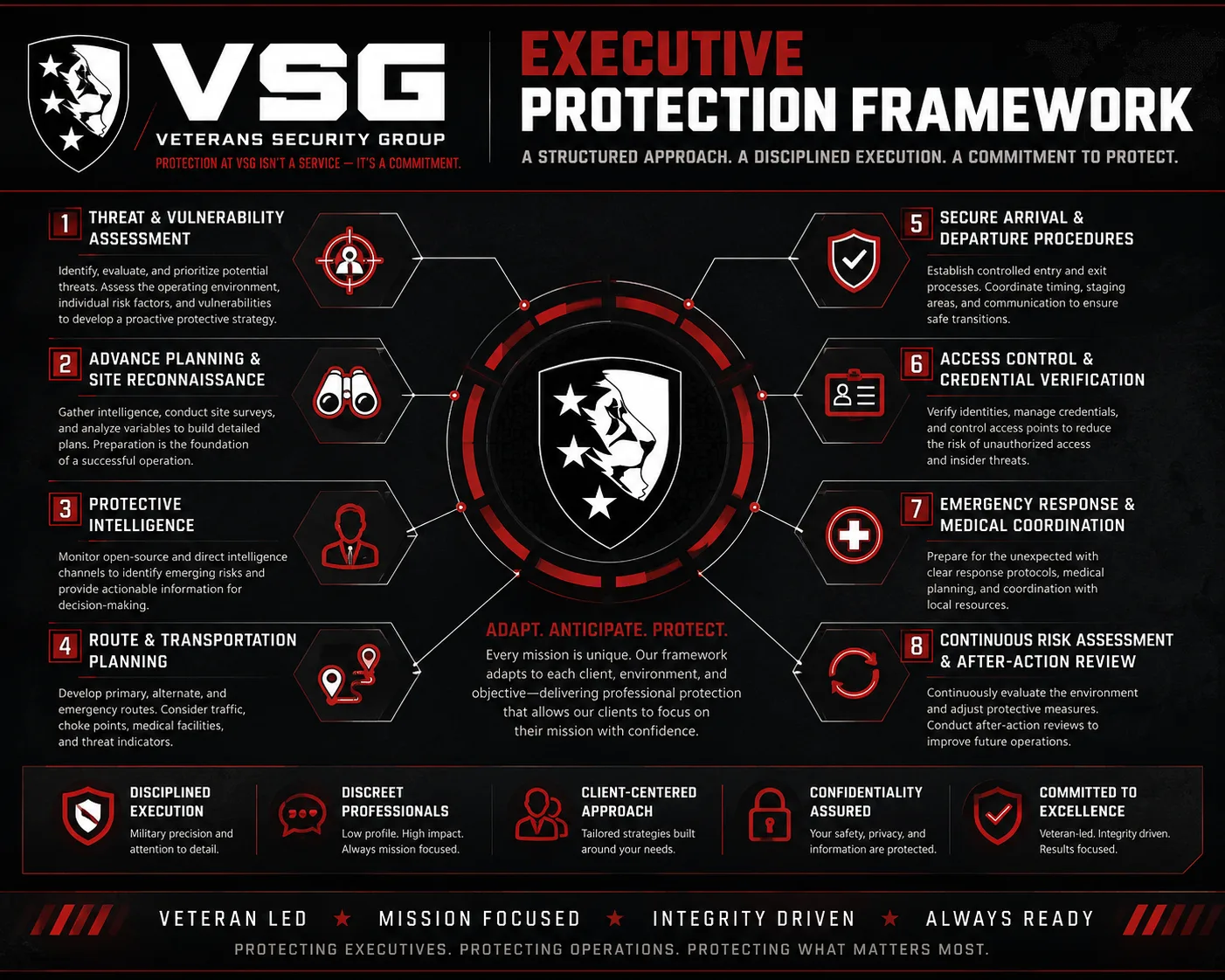
The VSG framework translates that principle into eight connected disciplines:
Threat and vulnerability assessment. Identify credible hazards, exposure, consequences, and existing controls. Separate verified information from rumor, and reassess when the person's role or environment changes.
Advance planning and site reconnaissance. Review destinations, access conditions, emergency resources, communications, and coordination requirements without creating unnecessary disruption for the business.
Protective intelligence. Monitor relevant, lawful information for changes that may affect the principal. Good protective intelligence is contextual and behavior-based; it is not speculation based on appearance, identity, or protected characteristics.
Route and transportation planning. Prepare primary and alternate movement options, establish communications, and account for predictable constraints while limiting unnecessary exposure of schedules.
Secure arrival and departure. Coordinate timing, entry, exit, staging, and site responsibility so the most vulnerable transitions are not left to improvisation.
Access control and credential verification. Confirm who should reach the principal, meeting area, vehicle, or restricted workspace, and define how exceptions are handled.
Emergency response and medical coordination. Establish roles, communications, medical resources, and transfer points appropriate to the mission and location.
Continuous risk assessment and after-action review. Capture what changed, what failed, and what should be corrected before the next movement.
Protective intelligence deserves particular care. The U.S. Secret Service National Threat Assessment Center describes behavioral threat assessment as a process for identifying concerning behavior, gathering information, assessing the risk of violence, and managing that risk through appropriate intervention. The value is not prediction with certainty. It is disciplined attention to behavior, context, corroboration, and lawful options for reducing risk.
This matters to cannabis organizations because the principal's safety and the business's continuity are connected. If leadership movement is disrupted, sensitive decisions, staffing, facility access, vendor relationships, and public confidence can be affected. Protection planning should therefore align with the company's broader crisis, communications, and continuity plans.
Not every executive needs a full-time protective detail. The right model may be a one-time risk assessment, event coverage, a travel advance, residential review, secure transportation, protective intelligence support, or a temporary program during elevated risk. The decision should follow evidence and mission requirements.
The strongest protective programs are discreet because most risk reduction happens through planning, coordination, and early decisions rather than visible reaction.
Operational standard
Before an executive movement or high-profile event, leadership should be able to answer:
What has changed in the principal's visibility, schedule, relationships, or threat environment?
Which information is verified, and who owns the assessment?
Have the destination, access responsibilities, communications, and emergency resources been reviewed?
Are schedules and personal information shared only with people who need them?
Who has authority to change or stop the plan when conditions change?
How will an incident be documented, communicated, and reviewed afterward?
The strongest protective programs are discreet because most risk reduction happens through planning, coordination, and early decisions rather than visible reaction.
Nexus insight
An intelligence platform can support executive protection by organizing relevant facility, travel, incident, and threat context into a clearer decision picture. It should help professionals identify change, verify sources, document uncertainty, and place time-sensitive information in front of the right reviewer.
It should not declare a person dangerous, automate high-consequence action, or replace an experienced protection professional. Human review, lawful information use, privacy controls, and documented accountability remain essential.
Work with VSG
VSG can help cannabis leaders determine what level of protection is justified, build a mission-specific plan, and integrate executive protection with the organization's wider security and continuity program.